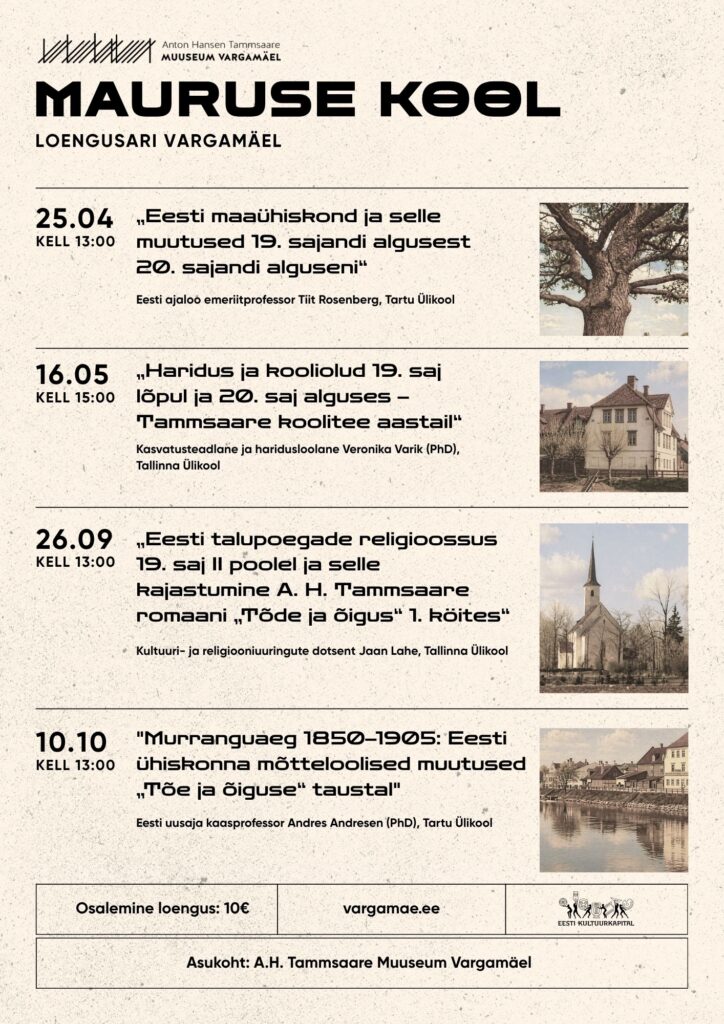
A. H. Tammsaare’s “Truth and Justice” is a foundational text in Estonian cultural history that does not lose its relevance even in changing times. The year 2026 marks an extraordinary milestone in Estonian cultural history — one hundred years since the first publication of Part I of Anton Hansen Tammsaare’s great work “Truth and Justice”. To mark the anniversary year, we invite you to take part in a special four-part lecture series in which distinguished lecturers will help explain the circumstances of the era of “Truth and Justice”, the spirit of the age, and Tammsaare’s life and work. The lecture series is called “Maurus School”, inspired by Volume II of “Truth and Justice”. The first lecture deals with peasant society and land-ownership relations from the beginning of the 19th century to the beginning of the 20th century, explaining terms such as saunikud, asunikud, popsid and vabadikud and analysing the rights and obligations connected with land ownership. The focus is on community relations and the central role of land in shaping social structure and values. The lecture will be given by Tiit Rosenberg, Professor Emeritus of Estonian History at the University of Tartu, Cand. Hist. The first lecture will take place on 25 April in the museum cattle barn at Vargamäe, in Vetepere village. The second lecture gives an overview of the organisation of education in Estonia at the time when Tammsaare began school, examining the systems of parish schools and village schools, the organisation of teaching, the role of the teacher, assessment, compulsory schooling, supervision and more. It also looks at the meaning of the schoolhouse as a community centre and the impact of educational reforms on the school network. The third lecture focuses on Tammsaare’s religious convictions and their reflection in the novel “Truth and Justice”, analysing the connections between Christianity and the ideological tensions of the work. The lecture helps to understand more deeply the writer’s religious and creative self-definition. The fourth lecture explores the currents of thought and ideological movements that developed in Estonian society from the mid-19th century to the early 20th century, looking at the young Tammsaare’s encounters with new ideas during his studies, later reflected in Part III of the novel. Come and discover Estonian literary classics from a new perspective. The lecture series is supported by the Estonian Cultural Endowment.