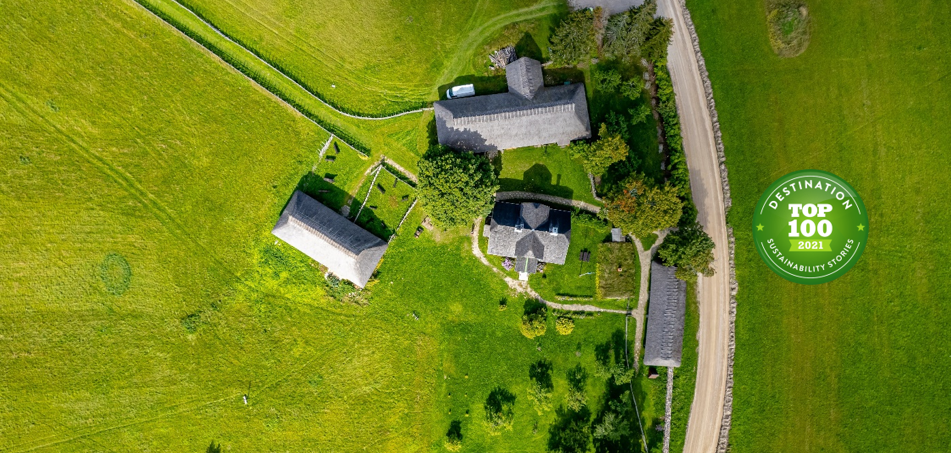
Dear visitor! We have created a guide for your museum visit that gives a brief overview of the museum buildings, the story of ‘Truth and Justice’, and the Hansen family. It also includes a few riddles and questions to think about; the answers are at the end. The story of the museum. After Part I of the novel ‘Truth and Justice’ appeared in 1926, many curious visitors came to Tammsaare’s home region. The museum was officially opened on the second floor of the residence built by the writer’s brother August Hansen on 30 January 1958. The arrival of the Hansens at Tammsaare-Põhja farm. Tammsaare’s parents Peeter and Ann Hansen reached Tammsaare-Põhja farm in 1872. They set out in April from Kolgioja farm in the Suure-Jaani area of Viljandi County with their household goods and two horses. The journey lasted two days, and they spent the night in a roadside spruce grove. When the Hansens arrived, the land and buildings at Tammsaare-Põhja were in relatively poor condition. The farm covered 138.9 hectares, of which 15.6 hectares were fields; the rest was marshy hay and pasture land. Before Peeter could start building new structures, a year or two passed because the fields needed to be reclaimed and the first ditch had to be dug in the hay meadow suffering from excess water. From the memories of the writer’s sister Marta Hansen: both father Peeter and mother Ann spoke about coming to Tammsaare. At our home farm there were then no trees and no hedge, no herb garden, nothing at all. The buildings were old and dilapidated. Here father immediately began building and repairing. First of all, he started building the dwelling house. The buildings of Tammsaare-Põhja farm, which in the novel is Mäe farm, or Andres’s farm, are the granary, the threshing-house dwelling, and the cattle barn. Some distance away are the cottagers’ buildings. The museum’s neighbouring farm is Tammsaare-Lõuna, which in the novel is Oru farm, or Pearu’s farm; it is privately owned, and descendants of Jakob Sikenberg, the prototype for Pearu of Oru, still live there today. When you enter through the museum’s main gate, you will notice a building on the left. This is the granary. It is the only building built by the writer’s father Peeter Hansen that has survived to this day. The granary had three sections, with an open passage between them where the sleigh and wagon were kept. The food granary held meat barrels and barrels of sauerkraut and Baltic herring. In the grain granary, the farm’s grain reserves were kept in bins, along with measuring containers and sacks of flour. In the clothing granary, also called the boys’ granary, the girls slept in summer. Clothes were stored in large chests along the wall. Excerpt from ‘Truth and Justice’: At home she went to the granary, and there she wept bitterly against her big white chest. Andres came after her and, finding her crying, stood silently for a while. Then he stepped nearer, without touching her, and said, ‘Krõõt, don’t cry. I only thought the rain would pour down and wet the rye, otherwise I wouldn’t have.’ That was what reconciled the wife with her husband that time. Questions about the granary: What is an old-fashioned festive shoe called? Riddle: it makes clothes for everyone, but is naked itself—what is it? What is the modern name for the open passage between the granary rooms? A piece has been cut away from the grain-granary door. Why? What was made in the cream churn? Why does the milk can have a spout? On the museum grounds there is another building similar to the granary. It is the long threshing-house dwelling, divided into three main parts: chambers, the threshing room, and the threshing-floor area. The building has an entrance hall and two chambers. In the front chamber there is the family dining table, two beds, and the farmer’s bench. From there you can enter the pantry. In the back chamber are the parents’ bed, a cradle, and a cupboard. The central room of the building is the threshing room. In one corner stands a large oven. It has no chimney; smoke and heat entered the room through an opening in the oven wall. The smoke was let out through the half-door. In autumn grain was dried on the rack above. On the threshing floor, grain was threshed in autumn, and in winter horses were kept there. In the rear part there was a pigsty divided in two. Fattening pigs were kept in the back section, and a sow with piglets in the front section. Next to the stall was the chaff store. Later Peeter Hansen built a wicker shed onto the rear of the house, where the outdoor pigs dozed in the straw and chaff heap. Horses were also kept there in summer. Questions about the threshing house: Riddle: a grey ox sleeps on the ground, lungs and liver move inside—what is it? What was the main and central food, the food held in great respect? With what was water carried? What is missing from the threshing-room oven? August’s house. The museum’s somewhat different house was built in 1934 by August, the family heir and the writer’s brother. It houses the ‘Truth and Justice’ exhibition, a figure of the writer in old age, the Hansen family tree, and more. In the yard you will see a large oak tree. This oak also appears on the 25-kroon banknote. The cattle barn. On one side were the cows and on the other the sheep. In the middle was a large utility room, and there were hay rooms on both sides. In front of the building were enclosures for gathering the herd. In front of the barn was Peeter Hansen’s tobacco patch. Today you can see large wooden animals in front of the building; they are enlarged versions of herdboys’ toys. In the past children herded the animals, making sure the herd stayed together and that wild animals did not harm it. Questions about the cattle barn: Riddle: a man ploughs, but there is no plough and no horse—what is it? Riddle: a hayfield mown twice a year—what is it? If you walk down along the herd path, you will see the cottagers’ buildings there. These dwellings were built on the boundary between the two farms. The three-room sauna house consisted of a threshing room, a chamber, and a threshing-floor area. One family lived in the chamber, the other in the threshing room. Each had its own pantry. One family’s animals lived in the threshing-floor area, the other’s in a small barn. Each family had its own granary. The boundary between Tammsaare-Põhja and Tammsaare-Lõuna ran between the living room and the threshing-floor area. The well. Walking downhill along the herd path, the cottagers’ buildings are on your left, but if you go right you reach the well of Tammsaare-Põhja farm. The Hansen family got their water from this well. Carrying water was women’s work. Water had to be brought for the animals, for washing laundry, for drinking, and for cooking. The cultural grove. Here you will also see trees with plaques beside them. This is the cultural grove of Järvamaa, where laureates of the county’s cultural prize have planted their trees. If you continue, you will reach the large village swing, smaller swings, and the literary adventure trail. The story of the Hansen family. Twelve children were born to A. H. Tammsaare’s parents Peeter and Ann Hansen, and ten of them grew up. Of the twelve, eight were boys and four were girls. At that time it was important for a farm family to have many sons and for the first child to be a boy. Normally the first son became the heir, but in the Hansen family the heir was the third son, August. The future writer Anton Hansen was born as the fourth son, in 1878. As a child, Anton Hansen watched his parents work, saw their dream of fertile land, and while herding cattle learned to know animals and plants and experienced nature in its purest form. Daily life on the farm, the marking of important events, and human relationships influenced him so deeply that in 1925 he began writing the novel ‘Truth and Justice’, which was published in 1926. Prototypes. Mother Ann Hansen / Krõõt and Mari. Krõõt is known as the embodiment of kindness, able to reconcile neighbours with a good word and lure pigs out of the rye. The model for this gentle woman was the writer’s light-voiced mother Ann Hansen, who sang to her children the same song with the mysterious phrase ‘Sink sale proo’ that Krõõt also sings. But Ann also had a sterner side: during quarrels she could remain silent for weeks. Traits of the mother can also be found in Andres’s second wife Mari. Mari was somewhat more strongly built than Krõõt, and Ann too became strong in build later in life. It was the mother who saw Anton Hansen off to school with her best wishes and kept worrying about his food, clothing, and shoes, just as Mari did when Indrek was away at school. Father Peeter Hansen / Andres. In Tammsaare’s father Peeter Hansen we find the same strong and determined worker as in Andres. Peeter was a skilful man who knew how to sow grain seed the way others could not. His great dream was also to gain land from the bog. Besides work, the father found time to be with the family. Anton Hansen can likewise be seen as a tireless worker like Peeter: he could write for 16 hours straight without sparing himself, until his finger cramped. The writer also needed self-discipline during a period of severe illness, when he had to live on a monotonous diet; even the slightest lapse might have led him to his death. Jakob Sikenberg / Pearu. Jakob Sikenberg was Peeter and Ann’s neighbour and lived on Tammsaare-Lõuna farm. Pearu is often seen as one of the negative characters, because it can seem hard to understand why he could not dig the ditch together with Andres and why he had to be so spiteful. Looking back into the past, however, we find several court records proving that the real-life counterparts of Pearu and Andres also went to court. But times were different then, and going to court could also be seen as a form of leisure. They went together and on the same wagon, because the road was one. The quarrel was never so great that if the neighbour held a feast, one would not go. Tammsaare’s sister Anette remembered the neighbour’s good sense of humour and generosity: when Jakob took honey, he also shared slices of bread with honey with the neighbour’s children. Read more about writer Anton Hansen Tammsaare and 19th-century farm life. Thank you for visiting the Tammsaare Museum at Vargamäe! Answers to the questions. Granary: 1) pastel shoe, 2) needle, 3) garage, 4) it is a cat hole so that the cat can get into and out of the grain granary and catch the mice that may cause trouble, 5) butter, 6) the spout was used for straining milk. Threshing house: 1) the house and the people inside it, 2) bread, 3) with a shoulder yoke, 4) a chimney. Cattle barn: 1) pig, 2) sheep.